“How long until my website ranks on the first page of Google?” is the single most common question business owners ask before investing in Search Engine Optimization.
Because digital marketing requires financial commitment, business leaders reasonably expect an estimated time-to-value. However, unlike paid advertising where traffic begins immediately upon activating a budget, SEO is an organic development process governed by complex, automated search algorithms.
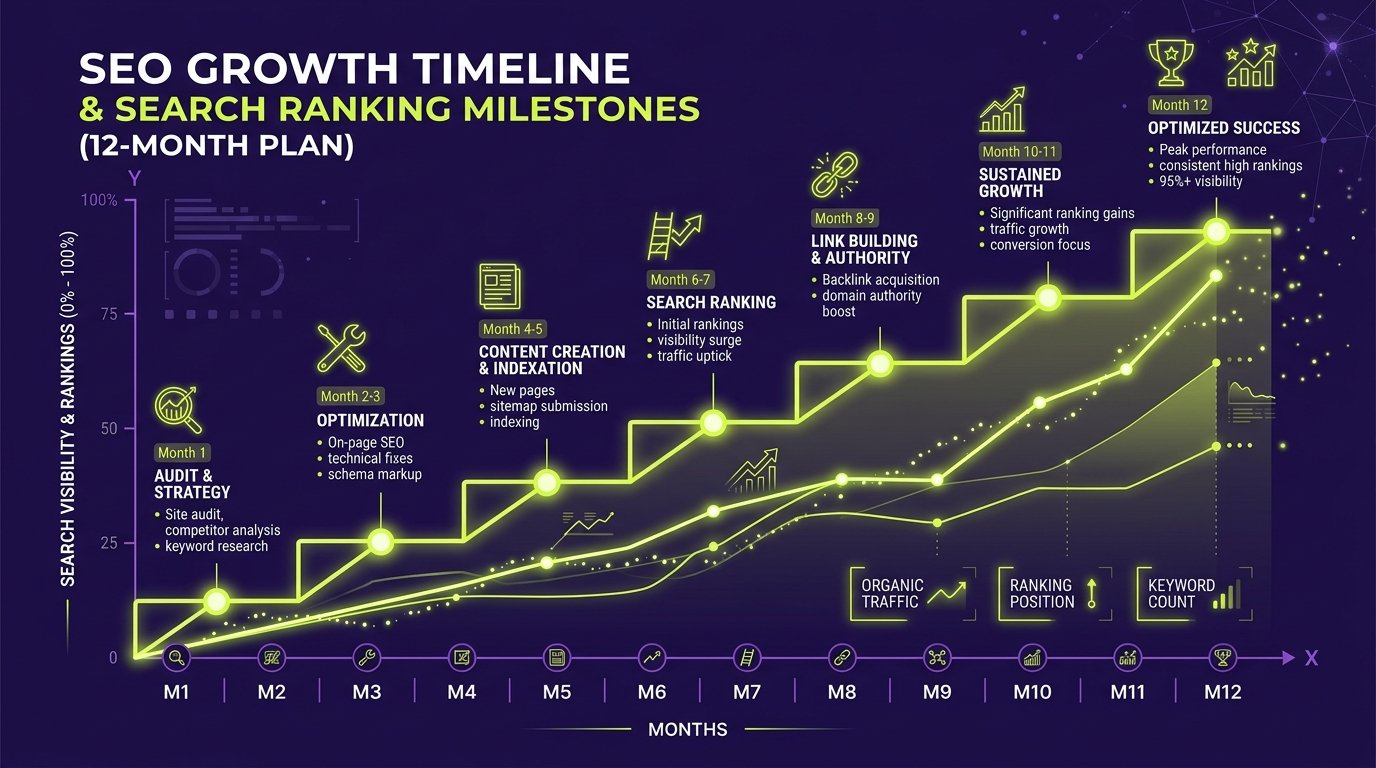
In the vast majority of commercial scenarios, meaningful SEO results take between 3 to 6 months to emerge, with substantial, compounding growth typically materializing between months 6 to 12.
Any agency or consultant promising guaranteed first-page rankings in 30 days is either using high-risk “black-hat” tactics that risk severe algorithmic penalties, or targeting obscure keywords that have zero actual search volume. In this guide, we explain what SEO progress actually looks like at each stage, the technical factors that govern your timeline, and how to evaluate whether your campaign is on track.
What “SEO Results” Actually Mean
Before evaluating timelines, it is essential to define what constitutes an SEO “result.” Achieving meaningful business outcomes through SEO is a staged progression rather than an overnight switch:
- Crawl & Technical Health (Month 1): Googlebot discovers your pages without errors, indexation rate increases, and technical barriers (such as broken links, slow Core Web Vitals, or redirect loops) are resolved.
- Impression Growth (Months 2–3): Google Search Console reveals that your site is showing up in search queries for relevant industry terms, even if rankings are initially on pages 3 to 5.
- Keyword Ranking Momentum (Months 3–6): Target secondary and primary keywords move steadily toward page 1 and page 2, accompanied by measurable increases in organic impressions and preliminary click traffic.
- Qualified Traffic & Conversions (Months 6–12): Target commercial pages achieve stable top positions, generating consistent organic visits, phone calls, quote requests, and sales.
Key Factors That Influence Your SEO Timeline
Why does one website see ranking improvements in 90 days while another takes 9 months? Several fundamental variables dictate the speed of organic progress:
1. Domain Age and Website History
A new domain registered last month has zero historical trust with Google. It operates in what the industry describes as a “sandbox” period while search engines evaluate its stability and authenticity. Conversely, an established business domain that has existed for five or ten years with a clean history and steady traffic can absorb optimizations and rank new content significantly faster.
2. Previous Penalties or Technical Debt
If your website previously engaged in questionable link schemes, has thousands of duplicate auto-generated pages, or runs on an outdated, sluggish content management system, significant time must first be spent undoing that technical debt before positive ranking movement can occur.
3. Competitive Landscape in Your Sector
Ranking for a local specialized B2B service (such as precision sheet metal fabrication in Hubballi or industrial packaging in Mysuru) involves far fewer entrenched organic competitors than ranking for nationwide consumer queries like “business loans” or “best CRM software.” The higher the authority of your competitors’ domains, the more sustained effort is required to surpass them.
4. Content Quality and Topical Authority
Google prioritizes websites that demonstrate comprehensive topical authority rather than isolated blog posts. Building out a complete cluster of supporting guides, service breakdowns, and FAQs takes time to research, write, review, and publish.
5. Technical Infrastructure & Site Speed
A modern, well-coded website that passes Core Web Vitals, renders cleanly on mobile devices, and features structured schema markup provides search crawlers with an immediate positive signal. If your site takes five seconds to load, search engines will hesitate to prioritize your content for mobile users. Professional website speed optimization plays a vital role here.
A Realistic Month-by-Month SEO Timeline
Month 1: Discovery, Technical Audits, and Remediation
- Complete crawl audit to identify indexation blockers, 404 errors, and duplicate content.
- Resolving Core Web Vitals issues, server response bottlenecks, and mobile rendering errors.
- Exhaustive keyword research mapped to exact user intent and existing URL structure.
- Baseline benchmark reporting in Google Search Console and Google Analytics.
Months 2–3: Architecture, On-Page SEO, and Indexation
- Rewriting title tags, meta descriptions, and header hierarchies (H1, H2, H3) across primary service pages.
- Implementing structured JSON-LD schema (WebPage, Service, Organization, FAQ).
- Strengthening internal linking to distribute PageRank to priority service pages.
- Publishing the first batch of high-depth pillar content.
- Expected metric: Notable surge in total search impressions in Google Search Console.
Months 4–6: Topical Authority and First Page-One Breakthroughs
- Expanding content clusters around secondary and long-tail commercial queries.
- Earning relevant local or industry citations and natural backlinks.
- Optimizing Google Business Profile listings and matching local landing pages.
- Expected metric: Lower-competition long-tail keywords enter top-10 positions; noticeable lift in organic click traffic.
Months 6–12: High-Intent Conversions and Compounding Value
- Primary high-volume commercial keywords begin ranking on page one.
- User engagement metrics (time on page, low bounce rates) reinforce search positions.
- Conversion rate optimization on top-performing landing pages to turn visitors into leads.
- Expected metric: Predictable, inbound inquiries and consistent organic lead generation.
Common Mistakes That Delay SEO Results
When campaigns stall beyond the six-month mark without measurable movement, the root cause is almost always one of these operational errors:
- Targeting Unrealistic Keywords Too Early: Attempting to rank a new website for broad national terms rather than specific commercial or regional queries.
- Publishing Thin, Generic Content: Re-hashing high-level information without adding genuine expertise, clear specifications, or practical insights.
- Ignoring Technical Foundations: Writing articles on a website that suffers from severe crawl errors, missing canonical tags, or slow server response times.
- Inconsistent Execution: Publishing five articles in month one, pausing for three months, and expecting steady organic growth. Search engines favor consistent, active websites.
- Premature Strategy Shifts: Changing target keywords or altering URLs every two months prevents search algorithms from establishing stable baseline rankings.
Why Reputable Agencies Never Guarantee Timelines or Rankings
Google’s official SEO documentation explicitly advises businesses: “Beware of SEOs that claim to guarantee rankings, allege a special relationship with Google, or advertise a priority submit to Google.”
Because Google updates its core ranking systems multiple times per year and continuously recalibrates algorithmic weighting across hundreds of ranking factors, no external agency controls Google’s index. What a professional SEO team can guarantee is methodical execution, technical adherence to Google’s Search Essentials, transparent data reporting, and continuous optimization based on real search signals.
Build a Predictable Organic Channel With Seyon
Ready to build a predictable organic search channel for your business? Review Seyon’s Professional SEO Services or contact our search strategists to receive an objective technical evaluation of your website’s current ranking potential.
Frequently Asked Questions
Can SEO ever deliver results in less than 30 days?
In rare cases, fixing a catastrophic technical error—such as removing an accidental noindex tag from an established website or repairing a broken robots.txt file—can restore lost rankings in a matter of weeks. However, for new content or competitive terms, a minimum of 3 to 6 months is standard.
How do I know if my SEO campaign is working before leads start coming in?
Monitor leading indicators in Google Search Console: total impressions, average keyword position trends, and the total count of indexed pages ranking for industry queries. When impressions trend upward consistently, click traffic and inquiries typically follow.
Does changing website design reset SEO progress?
It can if not managed carefully. A website redesign that alters URL structures without setting up permanent 301 redirects, strips out metadata, or deletes optimized copy can severely harm rankings. Properly managed website redesigns preserve existing URLs and search equity.
Is ongoing SEO necessary once my website achieves target rankings?
Yes. Search rankings are not permanent property. Competitors continually publish new content, algorithms change, and website code naturally degrades over time. Ongoing SEO protects your market share.