In bustling metropolitan commercial zones like Indiranagar in Bengaluru, T. Nagar in Chennai, RS Puram in Coimbatore, or Jayalakshmipuram in Mysuru, consumer discovery has shifted almost entirely to localized mobile search. Over 82% of smartphone users search for “near me” or localized service queries before calling, visiting, or purchasing.
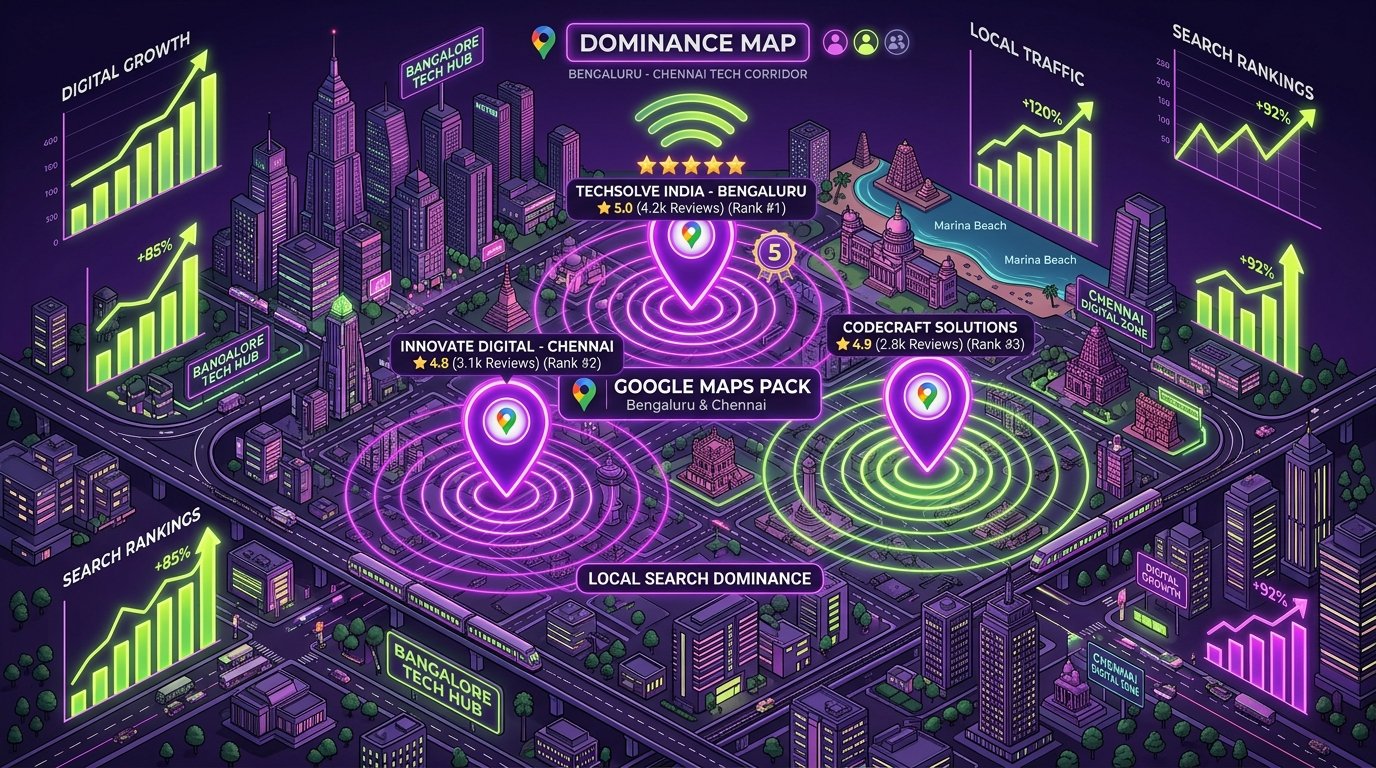
Yet, most local businesses in Karnataka and Tamil Nadu either neglect their local search presence entirely or rely on outdated directory listings. Dominating the coveted Google 3-Pack (Google Maps top results) and local organic rankings in 2026 requires an integrated strategy combining algorithmic proximity mastery, verified citation hygiene, dynamic review velocity, and localized technical schema.
1. Google Business Profile (GBP) Architecture in Dense Metro Clusters
Your Google Business Profile is the primary anchor of your local digital footprint. In hyper-dense clusters like Bengaluru or Chennai, where dozens of competitors exist within a 3-kilometer radius, basic profile completion is not enough.
Crucial Optimization Tactics
- Primary Category Exactness: Google attributes up to 60% of its initial algorithmic relevance to your primary category. Choose the most precise category (e.g., “Website Designer” or “Dental Clinic” rather than generic “Marketing Agency” or “Doctor”).
- Secondary Categories: Populate up to 5 highly relevant secondary categories to capture long-tail query clusters without diluting your primary focus.
- Weekly Geotagged Media Uploads: Consistently publish high-resolution photos of your actual office premises, team in action, client deliverables, and signage. Authentic images with natural EXIF location data signal genuine operational presence to Google’s neural matching models.
- Google Updates & Offers: Post weekly Google Updates (formerly Google Posts) highlighting seasonal offers, client case studies, and local announcements with direct appointment/call CTAs.
2. Proximity, Relevance & Prominence: The Local 3-Pack Algorithm
Google calculates local map rankings based on three pillars:
Relevance
How closely your business profile and linked website content match what the user is searching for.
Distance (Proximity)
How far each potential business location is from the location term used in the search or the user’s GPS coordinates.
Prominence
How well-known a business is, based on reviews, local press mentions, backlinks, and website domain authority.
While you cannot alter Google’s distance calculation, you can dramatically expand your prominence radius through authoritative on-page location silos and active local review acquisition.
3. Multi-Location Landing Pages for Multi-Branch Businesses
If your business operates across multiple locations (for example, Koramangala and Whitefield in Bengaluru, or Anna Nagar and OMR in Chennai), creating dedicated location landing pages is non-negotiable.
Avoid Doorway Page Penalties: Never simply copy the same text and swap the city name. Google’s helpful content systems penalize low-effort doorway pages. Each location page must feature:
- Exact branch address, unique local phone number, and branch manager or lead doctor/engineer bio.
- Interactive Google Map embed linking directly to that specific branch’s GBP listing.
- Location-specific customer testimonials, local case studies, and localized landmark directions.
- Structured JSON-LD
LocalBusinessschema markup specifying exact geo-coordinates, pincode, opening hours, and accepted payment types.
4. WhatsApp Review Generation Funnels & Sentiment Velocity
In India, email-based review requests have an open rate below 12%. By contrast, automated WhatsApp messages have an open rate exceeding 90%.
Implementing an automated post-purchase or post-service WhatsApp sequence that politely requests a Google review—complete with a direct shortlink that opens the review box with 5 stars pre-selected—can increase your monthly review velocity by 400%.
Crucial Tip: Always respond to every review within 24 to 48 hours. When responding, naturally incorporate your core service keywords and city name (e.g. “Thank you for choosing our custom web development services in Bengaluru!”) to reinforce localized semantic entity relevance.
5. Verified Indian NAP Consistency & Citation Networks
NAP (Name, Address, Phone Number) consistency remains a foundational trust signal. Inconsistencies between your website, your Google Business Profile, and regional Indian business directories confuse search engines and dilute local ranking signals.
Ensure your business details are strictly standardized across:
- Justdial and Sulekha profiles (ensure address matches Google Maps exact format).
- IndiaMART and TradeIndia B2B directories.
- MCA / Ministry of Corporate Affairs registered business filings.
- Social media profiles (Facebook Page, LinkedIn Company Page, Instagram Business Bio).
Want to Rank #1 on Google Maps in Your City?
Seyon Web Studio specializes in high-impact Local SEO, Google Business Profile optimization, and multi-location ranking strategies tailored for businesses across Karnataka and Tamil Nadu.