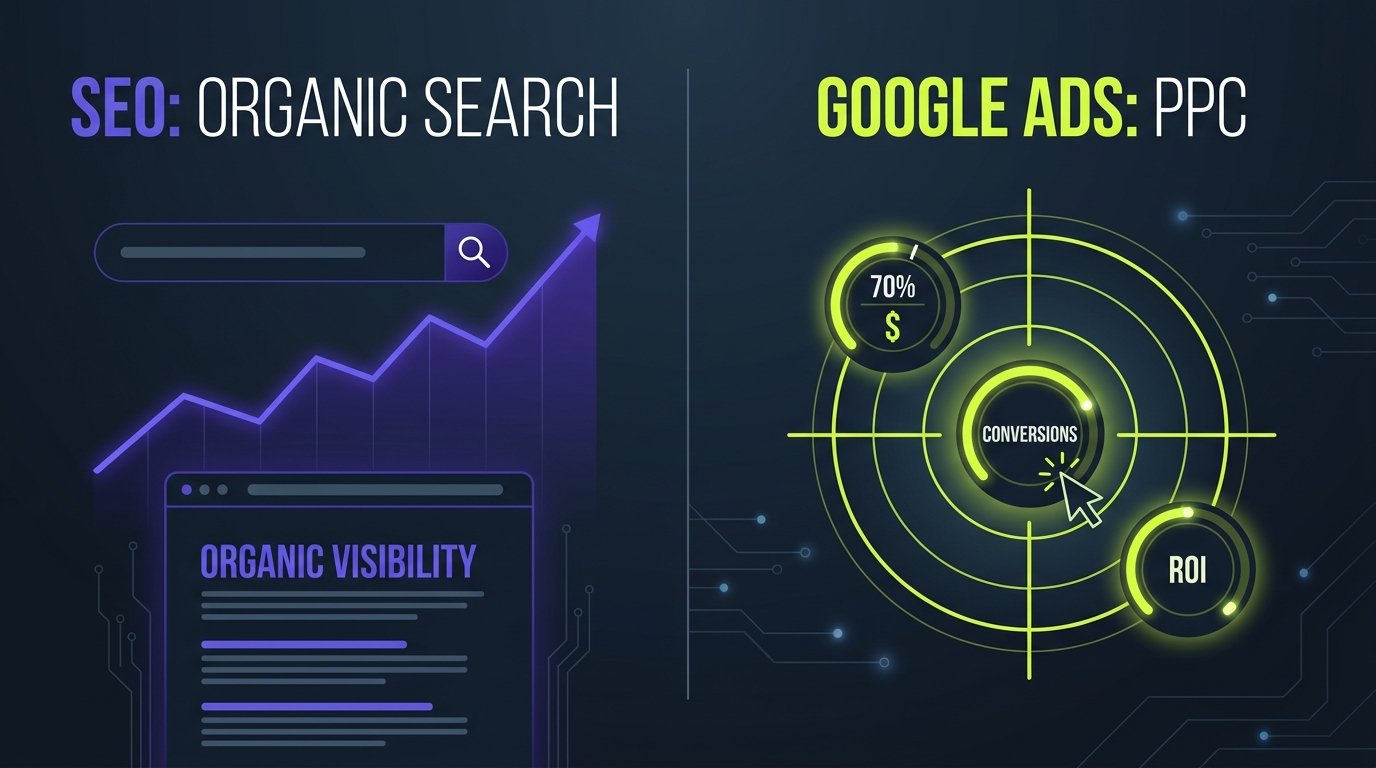
When planning your digital marketing budget, one of the most critical decisions is deciding where to invest your capital: Search Engine Optimization (SEO) or Google Ads (Pay-Per-Click). Both platforms operate on Google’s search engine results page, yet they function on entirely distinct economic, technical, and operational models.
Business owners frequently ask: Which channel will deliver a higher return on investment? Should we focus on ranking organically or paying for ad placements?
The short answer is that neither channel is universally superior. The right choice depends on your business model, cash flow, profit margins, timeline, and market competition. In this guide, we break down how both channels work, compare their fundamental differences, and provide a clear decision framework for your business.
Understanding the Fundamentals
What Is SEO?
Search Engine Optimization (SEO) is the practice of optimizing your website’s technical architecture, on-page content, user experience, and domain authority so search engines rank your pages organically for relevant queries.
When your website ranks organically, you pay nothing to Google when a user clicks on your listing. However, earning and maintaining those positions requires upfront and continuous investment in technical development, content creation, on-page optimization, and authority building.
What Are Google Ads?
Google Ads is Google’s paid advertising platform. It allows businesses to bid on specific search keywords so their sponsored listings appear at the top or bottom of Google search results pages.
With Google Ads, visibility is instantaneous once campaigns are configured and approved. However, it operates on a pay-per-click (PPC) model: every time a prospective customer clicks your ad, you pay a fee regardless of whether that visitor converts into an inquiry or sale. The moment you pause your daily ad budget, your traffic ceases completely.
Key Differences Between SEO and Google Ads
| Factor | Search Engine Optimization (SEO) | Google Ads (PPC) |
|---|---|---|
| Speed to Results | Requires sustained effort; typically 3–6+ months for meaningful momentum. | Immediate; ads can appear within hours of launching a campaign. |
| Cost Structure | Upfront retainer or development investment; zero cost per organic click. | Direct cost per click (CPC) paid to Google plus management fees. |
| Traffic Sustainability | Compounding asset; organic traffic continues even during quiet operational periods. | Finite; traffic drops to zero the moment the ad budget stops. |
| User Trust & CTR | Organic listings capture the majority of search clicks and higher consumer trust. | Marked as “Sponsored”; clicks are highly targeted with immediate commercial intent. |
| Keyword Reach | Can rank for hundreds of informational, long-tail, and commercial queries. | Limited strictly to the keywords you actively fund and bid on. |
| Control & Testing | Changes take time for Google to crawl, index, and reflect in rankings. | Full control over ad copy, landing page destinations, bidding, and negative keywords. |
Time to Results: Momentum vs. Immediacy
The most obvious contrast between the two channels is the timeline to see business outcomes.
- Google Ads delivers instant market feedback. If you launch a promotional campaign on Monday morning for an industrial machinery supplier in Coimbatore, prospective buyers can click through to your dedicated landing page by afternoon. This makes paid search invaluable for seasonal promotions, urgent service launches, or businesses that need lead flow immediately to support cash flow.
- SEO is a long-term operational asset. Google must crawl your website, evaluate technical performance (such as Core Web Vitals and crawl accessibility), parse content depth, analyze user engagement signals, and gauge topical authority against established competitors. While initial technical fixes may yield indexing improvements within weeks, competitive commercial rankings take months of deliberate execution.
Cost Structure and Long-Term Value
A common misconception among business owners is that “SEO is free while Google Ads is expensive.” In reality, both require dedicated capital.
- The Economics of Google Ads: Google Ads offers predictable cost control. You set a strict daily budget, choose target geographic boundaries, and control maximum bids. However, in competitive commercial sectors—such as corporate legal services, enterprise software, or commercial interior design—cost-per-click rates can be substantial. If your website’s conversion rates are sub-optimal, ad budgets can deplete rapidly without yielding positive ROI.
- The Economics of SEO: SEO behaves like an equity investment. You invest in improving your digital foundation—fixing site architecture, improving loading performance, building comprehensive service resources, and earning organic citations. While the initial months may show a higher cost-per-acquisition while rankings mature, the long-term cost per lead drops significantly over time as hundreds of organic pages attract continuous traffic without incremental click fees.
User Intent and Click-Through Behavior
Search engine users interact differently with paid advertisements versus organic listings:
- High Commercial Urgency (Favors Google Ads): When a customer searches for an urgent service—such as an emergency plumbing repair or immediate logistics support—they frequently click the first verified sponsored result that solves their immediate need.
- Research and Evaluation (Favors SEO): When a buyer is researching solutions, evaluating vendors, or comparing technical specifications, they often bypass sponsored links in favor of authoritative organic articles, detailed case guides, and primary service pages. Organic results historically capture between 65% to 80% of all search clicks across informational and non-branded commercial queries.
When SEO Makes the Most Sense for Your Business
Investing primarily in SEO services is the recommended path when:
- You want sustainable, long-term brand equity: You want your website to generate inquiries consistently without depending perpetually on daily ad spend.
- You operate in an educational or considered-purchase market: Your customers take weeks or months to evaluate options and require detailed guides, technical comparisons, and informational content before reaching out.
- Paid search CPCs are unsustainably high: In industries where click costs are prohibitively expensive for your unit economics, ranking organically allows you to acquire customers at a sustainable acquisition cost.
- You are building an expansive content library: E-commerce stores with hundreds of product categories or B2B businesses with diverse service lines benefit immensely from organic crawlability and content clustering.
When Google Ads Makes the Most Sense
Investing in Google Ads is the ideal primary channel when:
- You need leads or sales immediately: You are launching a new enterprise, introducing a new product line, or need to fill capacity for the upcoming quarter.
- You are testing a new product, offer, or value proposition: Google Ads allows you to send targeted traffic to dedicated landing pages to validate conversion rates, pricing models, and customer interest before committing to long-term SEO content production.
- You run time-sensitive promotions or seasonal campaigns: Festive campaigns, limited-seat industry webinars, or seasonal product sales require instant visibility that SEO cannot deliver on short notice.
- Your organic competitors have entrenched domain authority: If established legacy players dominate page one for your target terms, Google Ads provides immediate placement above them while your long-term organic strategy builds momentum.
The Hybrid Approach: When to Use Both Together
For established small and mid-sized enterprises, treating SEO and Google Ads as complementary disciplines rather than competing alternatives produces the strongest overall performance.
A practical dual-channel framework looks like this:
- Keyword Intelligence Sharing: Run Google Ads search campaigns to identify high-converting commercial keywords. Once you identify which specific search queries generate qualified inquiries rather than casual clicks, prioritize those exact terms for organic content and on-page SEO targeting.
- SERP Domination: For your highest-margin core offerings, having both a sponsored ad and a top-three organic ranking doubles your brand’s presence on Google, increases consumer trust, and pushes competitors further down the screen.
- Remarketing Organic Visitors: Visitors who discover your website through organic blog posts or service guides can be re-engaged through targeted Google Display or Meta remarketing campaigns to guide them back into your sales funnel.
Decision Framework: How to Choose for Your Business
To determine your initial allocation, evaluate these three questions:
- What is your financial runway? If your business requires revenue within the next 30 to 45 days to sustain operations, allocate the majority of your budget to paid search. If you have a stable operating base and want to build a lower-cost customer acquisition engine for the next three years, prioritize SEO.
- What is your website’s current condition? If your website has serious technical errors, poor mobile responsiveness, or slow loading speeds, sending paid traffic to it will waste ad spend. Address your website development and technical foundation first.
- What are your customer’s search habits? Are people searching for quick transactions, or are they searching for comparisons, how-to guides, and detailed vendor capabilities? Match your channel to the dominant intent of your target market.
When to Hire a Professional Agency
Navigating digital search channels requires distinct technical skill sets. SEO involves deep technical auditing, site speed engineering, schema architecture, semantic content modeling, and backlink development. Google Ads requires bid management, audience segmentation, negative keyword filtering, conversion tracking configuration, and ad-copy split testing.
Hiring an experienced search agency prevents costly missteps—such as running paid ads on broad match keywords that burn budget on irrelevant queries, or investing in SEO content that fails to rank due to underlying technical indexation errors.
Build a High-Performing Search Strategy With Seyon
Looking to build a sustainable search presence or capture qualified leads immediately? Explore Seyon’s SEO Services and Google Ads management, or get in touch with our digital marketing specialists to evaluate the right search strategy for your business goals.
Frequently Asked Questions
Can a business stop doing SEO once it reaches page 1 on Google?
No. Search rankings are dynamic. Google frequently updates its ranking algorithms, and competitors continuously optimize their content, technical speed, and authority to capture higher positions. Maintaining rankings requires ongoing content updates, technical maintenance, and regular SEO monitoring.
Does spending money on Google Ads help your organic SEO rankings?
No. Google maintains a strict separation between its paid advertising platform and its organic ranking algorithms. Running Google Ads will not artificially boost your organic positions. However, the traffic and brand awareness generated by ads can lead to indirect benefits, such as direct navigational searches or natural third-party mentions.
Which is cheaper in the long run: SEO or Google Ads?
SEO is generally more cost-effective over a multi-year horizon because organic traffic does not carry a per-click fee. Once a page earns high-ranking organic positions, it can generate qualified visits for months or years with moderate maintenance costs, whereas Google Ads costs scale directly with traffic volume.
Can small businesses with limited budgets succeed with Google Ads?
Yes, provided the campaign is tightly structured. Small businesses should focus on high-intent exact-match keywords, restrict geographic targeting strictly to their active service areas, implement exhaustive negative keyword lists, and direct clicks to dedicated, fast-loading landing pages designed specifically for inquiries.